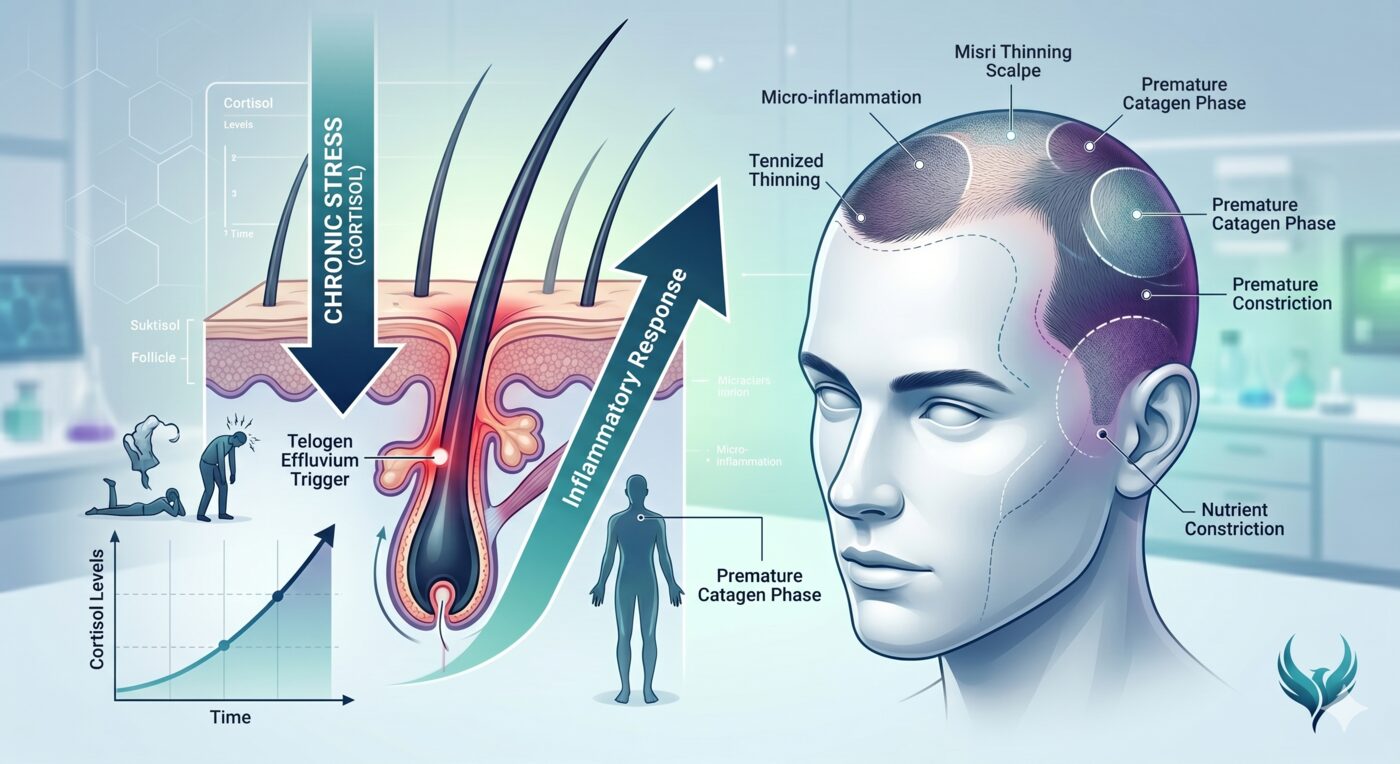
Hair loss is often experienced as an inevitability. While genetics are the primary driver of androgenetic alopecia, a silent enemy frequently acts as a catalyst: chronic stress. At Phoenix Hair Paris, we observe daily that stress is not merely a psychological sensation — it is a powerful biological disruptor that directly targets your hair follicles.
The Biology of Hair: A Fragile Life Cycle
Each hair follicle follows an autonomous three-phase life cycle:
- Anagen (Growth) Phase: the active phase lasting 2 to 7 years, during which the follicle produces keratin. Approximately 85% of hairs are in this phase at any time.
- Catagen (Transition) Phase: a short regression phase of 2 to 3 weeks during which keratin production stops.
- Telogen (Rest and Shedding) Phase: the hair remains attached for approximately 3 months before falling, pushed by a new anagen hair beginning its cycle.
Cortisol: The Hormone That Sabotages the Follicle
Under perceived stress, your body activates the hypothalamic-pituitary-adrenal (HPA) axis, triggering massive cortisol production. While this hormone is essential in the short term, its chronic presence is devastating for the scalp.
A. Inhibition of Growth Factors
Cortisol signals follicles to prematurely halt the anagen phase. It inhibits key proteins and growth factors (IGF-1, VEGF) essential for the proliferation of hair matrix cells.
B. Scalp Micro-inflammation
Chronic stress induces a low-grade systemic inflammatory state. At the scalp level, this micro-inflammation alters the immediate environment of the follicle, disrupting its vascularisation and nutrient supply.
C. Vascular Constriction
Stress activates the sympathetic nervous system, causing vasoconstriction. The micro-vessels nourishing the dermal papilla contract, limiting oxygen and amino acid supply. The hair slowly "suffocates".
Telogen Effluvium: When Stress Triggers Massive Hair Loss
Cortisol simultaneously pushes a large number of anagen follicles into premature telogen phase. The actual shedding occurs approximately 3 months later — the time required for telogen-phase hairs to complete their rest period. Unlike androgenetic alopecia (localised), telogen effluvium causes diffuse shedding across the entire scalp. It is generally reversible once the stress source is identified and managed.
Stress: An Accelerator of Genetic Alopecia
In individuals predisposed to androgenetic alopecia, stress has a more insidious impact. The micro-cellular inflammation it triggers accelerates the miniaturisation of follicles already weakened by DHT. A follicle that might have taken 10 years to atrophy through genetics alone can do so in 3 to 4 years under the combined influence of stress and cortisol.
Breaking the Vicious Cycle: Solutions in Paris
- Mindfulness Meditation: scientifically proven to significantly reduce cortisol
- Regular Physical Activity: metabolises excess stress hormones
- Sleep Optimisation: sleep deprivation is itself a major stressor
- Capillary Mesotherapy: injects nutritive cocktails directly into the scalp to compensate for stress-induced vasoconstriction
- PRP (Platelet-Rich Plasma): repairs micro-cellular inflammation and forces telogen follicles back into the anagen phase
Conclusion
Cortisol acts as a slow poison for your hair follicles. Understanding this psychobiology is essential. If you notice diffuse shedding, it is time to act on your lifestyle and consult specialists to support your hair health. Book your free consultation.