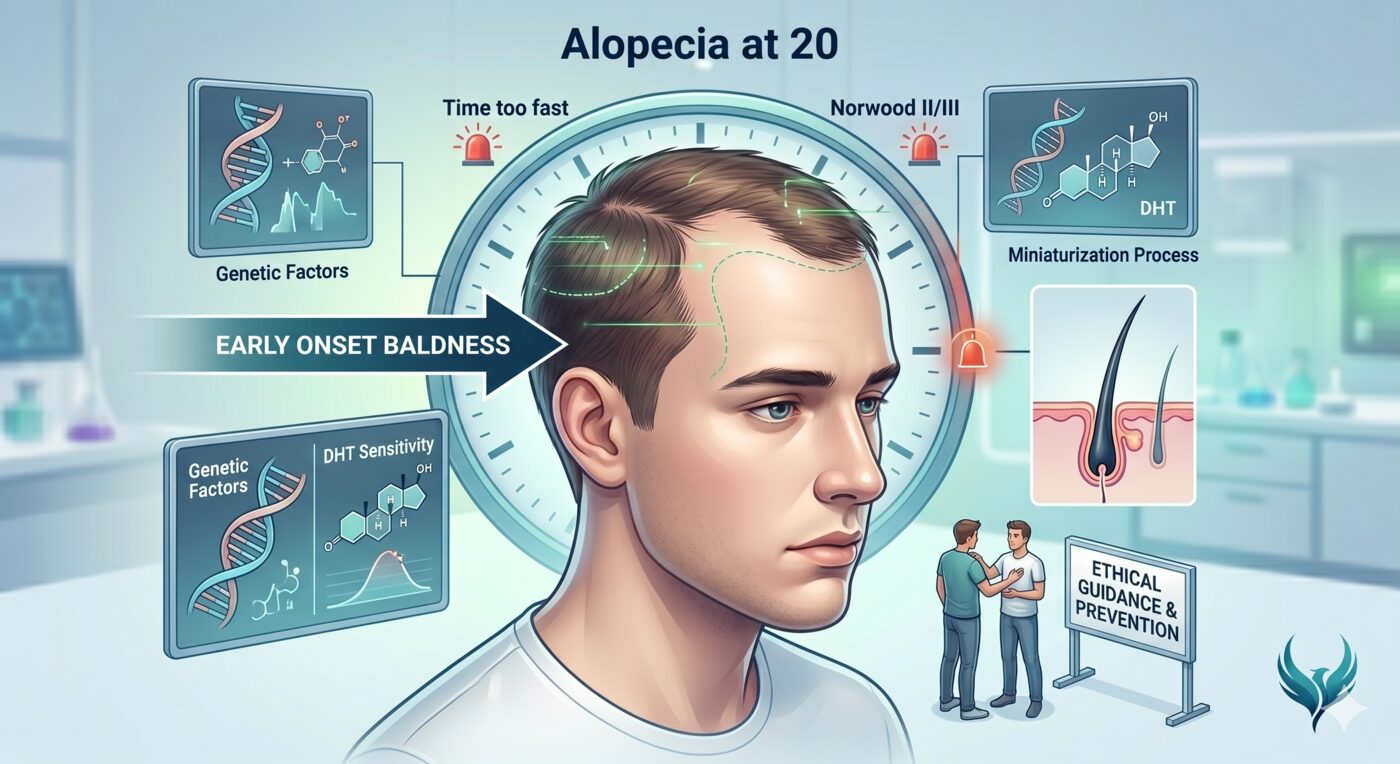
The appearance of the first signs of baldness is a psychological ordeal, all the more so when it occurs as early as age 20. Early hair loss has a devastating impact on self-image, confidence and social life. Faced with this, the temptation to turn to FUE or DHI hair transplantation is strong. However, at Phoenix Hair Paris, we approach transplantation in patients under 25 with extreme caution and rigorous medical ethics.
The Biology of Early-Onset Alopecia
Androgenetic alopecia causes 95% of all baldness. In patients with early alopecia, the DHT receptors on frontal and vertex follicles are hypersensitive. From the end of puberty, when male hormone levels peak, the miniaturisation process begins with particular aggressiveness.
Under the effect of DHT, the anagen phase progressively shortens. The follicle produces increasingly thin, short and depigmented hairs until it atrophies permanently. At 20, this cycle accelerates dramatically.
The Disaster of Premature Transplantation: The Donor Zone Trap
Unstabilised Evolution
Alopecia beginning at 20 is aggressive and has not yet revealed its final pattern. If we transplant a perfect frontal hairline today on a Norwood 2 patient, we consume a precious capital of grafts from the donor area without knowing at which stage (Norwood 5, 6 or 7) the alopecia will stop.
The "Transplanted Island" Syndrome
If the alopecia progresses over the next 5 to 10 years, the patient will be left with a dense transplanted hairline (transplanted hairs do not fall) surrounded by a void of native hairs. This unnatural "island" surrounded by baldness will require a new transplant — but the donor area may be exhausted.
At Phoenix Hair Paris, our principle is clear: we do not transplant to satisfy an immediate desire at the expense of future aesthetics.
The Phoenix Hair Ethical Strategy for Young Patients
A. Medical Stabilisation: Mandatory Before Age 25
- Minoxidil (topical application): increases follicle vascularisation and prolongs the anagen phase
- Finasteride (by medical prescription): blocks the conversion of testosterone to DHT — the most effective treatment for stopping androgenetic hair loss. We discuss its benefits and risks ethically with each patient.
B. Non-Invasive Revitalisation Treatments
- PRP (Platelet-Rich Plasma): repairs DHT-weakened follicles, thickening hairs in early miniaturisation
- Capillary Mesotherapy: nutrient injections to fortify the hair shaft and compensate for tissue deficiencies
C. Long-Term Donor Zone Planning
If, after medical stabilisation (at least 1 to 2 years), a transplant is considered, it must be conservative. We plan donor zone usage by anticipating future alopecia. The goal is not to restore a youthful density, but to redefine a mature and lasting hairline.
Conclusion
Hair loss at 20 is an emotional emergency, not a surgical one. Our medical ethics require us to protect our young patients from the risks of premature transplantation. The winning strategy relies on medical stabilisation, non-invasive solutions and long-term planning of your precious follicular capital. Your future hair is built today through prevention.