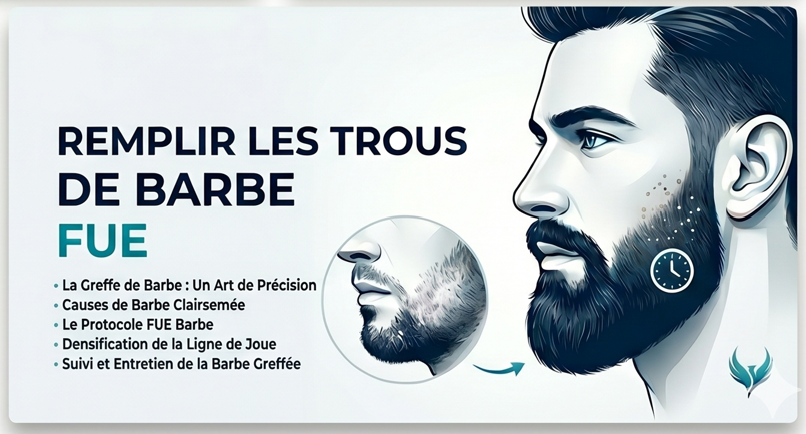
The beard has become a powerful marker of masculine identity — but for millions of men, sparse zones, bare cheeks or scars make it a source of constant frustration. This guide addresses the issue directly: why do these gaps appear, what can realistically be done, and when does surgery become the only serious answer?
What you see in the mirror is not a coincidence
A beard only grows where active hair follicles exist. If a zone is empty, the follicles are either genetically absent, damaged, or blocked by a pathological process — not because of poor grooming or diet.
The real causes of beard patches
Genetics: responsible in 80% of cases
The distribution of facial hair is primarily a matter of genetic programming, modulated by local sensitivity to DHT (dihydrotestosterone). The most commonly affected zones:
- The upper cheeks, between the cheekbone and the temple
- The junction between the moustache and the rest of the beard
- The chin and goatee area
- Overall symmetry (one side fuller than the other)
If your father or maternal uncles had the same configuration, it is hereditary. No serum, oil, or supplement will change this biological reality.
Beard alopecia areata
Alopecia areata barbae is an autoimmune disease in which the immune system attacks hair follicles, causing localised, often sudden hair loss. Rapid onset, sharply defined patches, smooth skin — these are its hallmarks. Important: a beard transplant on an active alopecia zone is contraindicated — at least 12 months of disease stability is required before surgery.
Scars
Deep cuts, burns or severe cystic acne can irreversibly destroy follicles. Scar tissue produces no hair naturally. FUE transplantation is the only medically viable option in such cases.
Aggravating factors
Nutritional deficiencies (zinc, iron, biotin, vitamin D), chronic stress, and hormonal imbalances can reduce beard quality — but correcting a deficiency will never make hair grow where follicles are genetically absent.
What works — and what does not
Non-surgical treatments
Topical minoxidil can awaken dormant follicles in certain low-density areas. Results vary, stop when treatment stops, and have no effect on follicle-free zones. PRP (platelet-rich plasma) can stimulate weakened follicles as a complement to a transplant. These treatments have their place, but none creates new follicles.
FUE beard transplant: the only definitive solution
FUE beard transplantation harvests healthy follicular units from the back of the scalp (a genetically stable zone) and reimplants them in the deficit areas of the face. The result is permanent: the grafts retain their genetic programming, grow indefinitely, and are maintained exactly like a natural beard.
The FUE beard protocol
Initial consultation
The most important step: evaluating the exact nature of the problem, donor zone quality, the number of grafts needed (500 to 2,500 depending on extent), and a target design tailored to your facial morphology. A serious practitioner will be clear about what is achievable and what is not.
The procedure
Performed under local anaesthesia, as an outpatient, in one day. Duration: 4 to 8 hours. Phase 1 — individual follicle extraction with a 0.7–1 mm micro-punch (no linear scar). Phase 2 — each graft placed respecting the exact angle and natural direction of facial hair. A single session is sufficient in the vast majority of cases.
Regrowth timeline
- Weeks 2–4: transplanted hairs shed — normal, does not indicate failure
- Months 3–4: visible regrowth begins
- Months 9–12: final result appreciable
Conclusion
Beard patches result from an absence or destruction of follicles that no surface product can compensate for. FUE beard transplantation is the only technique that provides a permanent, natural, medically validated answer. Phoenix Hair Center receives patients in consultation in Paris (52 avenue de la Bourdonnais, 7th arrondissement). Book your free consultation.