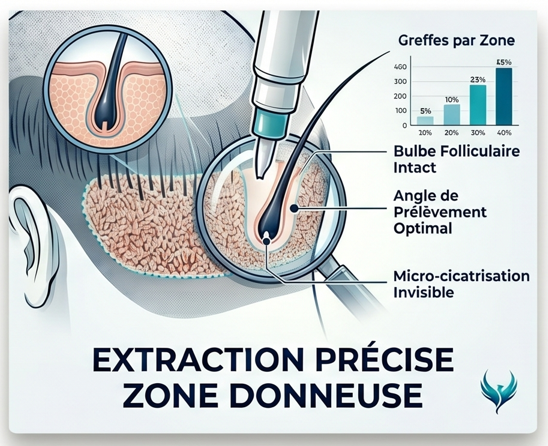
In FUE hair transplantation, everything begins and ends with the quality of the donor area. It determines how many grafts can be obtained, the quality of the transplanted follicles, and the durability of results. Yet it is often the least-explained aspect in consultations.
The fundamental principle: relocate without destroying
FUE transplantation rests on a compelling biological logic: certain follicles are genetically programmed never to fall out, even in the presence of the hormones responsible for baldness. The procedure harvests these robust follicles and relocates them to deficient areas. As an autograft, there is no immunological rejection risk — and the transplanted follicles retain their original genetic programming, making results permanent.
The donor area: why the back of the scalp?
DHT resistance: the decisive criterion
Male pattern baldness is caused by follicular sensitivity to DHT (dihydrotestosterone). The defining characteristic of the occipital zone is that its follicles are genetically insensitive to DHT. No matter how advanced the baldness, this hair will never fall. Once transplanted, the follicles retain this hormonal resistance in their new location.
Anatomical limits
The donor area also extends to the sides of the head. Its follicular density — expressed in follicular units per cm² — is the key parameter assessed during consultation. A typical zone presents 60 to 100 follicular units per cm², each containing 1, 2, 3 or up to 4 hairs.
The FUE extraction technique
FUE extracts each follicular unit separately using a circular micro-punch of 0.7 to 1 mm in diameter. The incision angle must follow exactly the follicle's orientation beneath the skin — which varies across zones and between individuals. Too shallow: the follicle is sectioned. Too deep: adjacent structures are damaged. This apparent simplicity conceals one of the most technically demanding gestures in hair surgery.
How to preserve donor area density
The 30% rule: the limit not to exceed
An experienced practitioner never harvests more than 30% of available follicles. Beyond this threshold, visible thinning of the donor area becomes perceptible. For a standard patient, the extractable follicular capital over a lifetime is between 4,000 and 8,000 grafts.
Homogeneous distribution: the signature of expert work
An inexperienced practitioner may over-harvest a localised central zone, creating a visible density hole. An expert distributes extractions homogeneously across the entire available surface, maintaining a minimum spacing between each site.
Frequently asked questions
Do donor area hairs regrow after extraction?
No. An extracted follicle is permanently removed. It is impossible to harvest twice from the same site. This is why managing follicular capital is a strategic, not cosmetic, consideration.
Can the micro-scars be seen?
In the vast majority of cases, no. The punctiform micro-scars (0.7–1 mm) become invisible after full healing, provided distribution was homogeneous and the 30% threshold was not exceeded.
Is the donor area evaluated during consultation?
Yes — and if it is not evaluated seriously, that is a warning sign. Donor area assessment is the basis of any realistic transplant plan.
Conclusion
The donor area is a unique, limited and non-renewable biological capital. Its rigorous management is what distinguishes a successful long-term transplant from one that leaves the patient with a depleted donor zone. At Phoenix Hair Center, donor area assessment is the systematic starting point of every consultation. Book your free consultation in Paris.