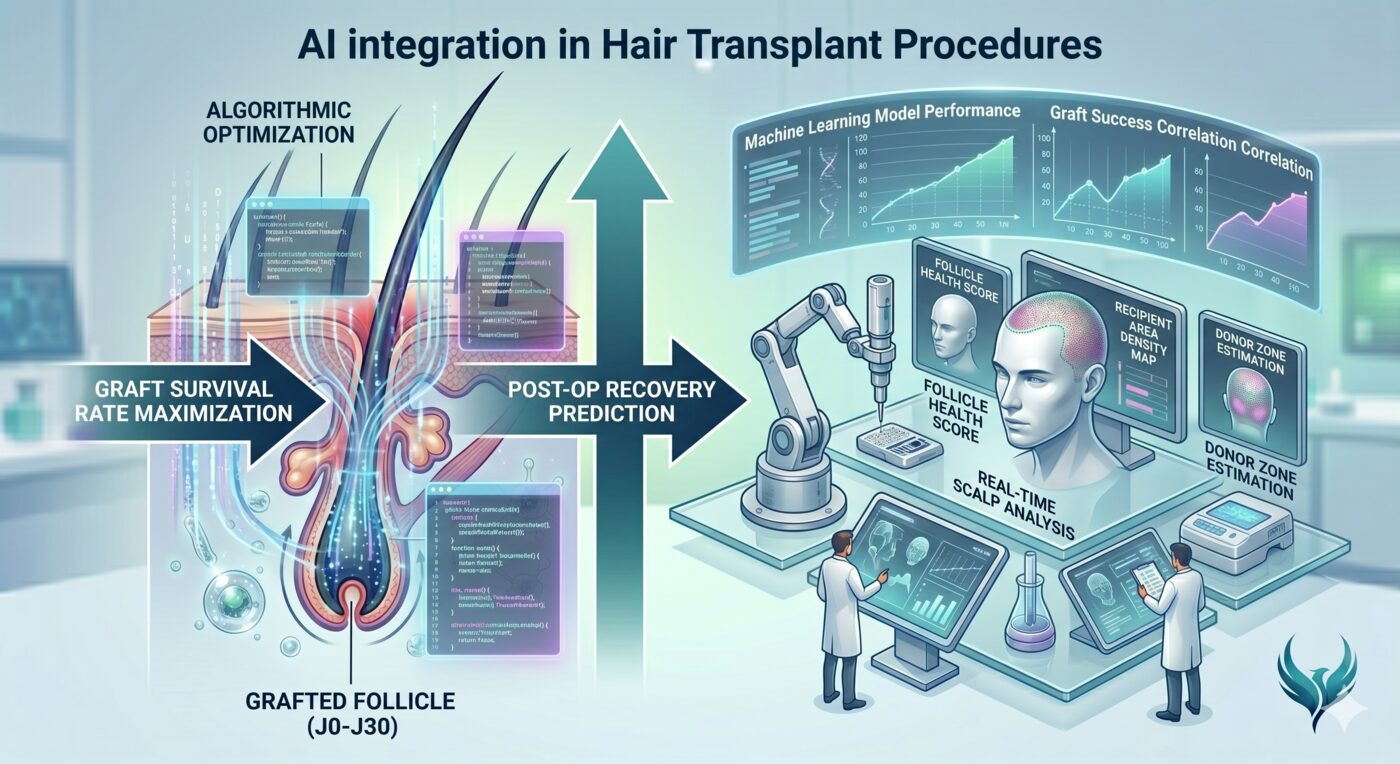
FUE hair transplantation has reached an exceptional level of technical maturity. Yet the limits of human performance — visual fatigue, imprecision in repetitive micrometric gestures, inability to analyse millions of follicular data points in real time — are now being overcome by technology. We have entered the era of AI-Optimised Hair Transplantation. At Phoenix Hair Paris, we position ourselves at the forefront of this revolution.
1. Pre-Operative Analysis: The Follicular Density Map
Our AI-assisted FUE imaging systems use computer vision algorithms (Machine Learning) to analyse macroscopic images of the patient's scalp. The AI automatically segments and counts each follicular unit, distinguishing follicles containing 1, 2, 3 or 4 hairs.
The algorithm also analyses each hair's calibre, scalp health and predicts a Follicular Health Score. This data enables planning extraction with surgical precision — using only the most robust grafts while preserving donor zone homogeneity.
2. AI-Assisted FUE Extraction: Micrometric Precision Robotics
Extracting thousands of grafts is repetitive and fatiguing, increasing transection risk. AI coupled with robotics eliminates this risk.
The Emergence Angle Tracking Algorithm
During extraction, a computer vision system analyses in real time (100 times per second) the precise emergence angle of each hair beneath the skin. The AI instantly adjusts the micro-punch orientation to follow the follicle's natural direction and extract it undamaged.
Optimal Extraction Rate
The algorithm calculates a random and homogeneous extraction pattern, ensuring no zone is over-harvested. The transection rate drops to less than 2%, compared to 5 to 10% in conventional manual FUE.
3. AI-Assisted Implantation: Graft Survival Prediction
Angiogenesis Modelling
From pre-operative tissue health data, the AI models the recipient area's capacity to generate new vascularisation (angiogenesis).
Survival Rate Maximisation
The AI simulates implantation and predicts the Graft Survival Rate based on implantation density and graft placement depth. This data guides our physicians during DHI (Direct Hair Implantation) to select the ideal angle and depth for each graft, maximising its anchoring probability.
Conclusion
Artificial intelligence does not replace medical expertise — it amplifies it. In 2026, Phoenix Hair Paris offers patients AI-Optimised Hair Transplantation: a high-technology FUE/DHI where every follicle is analysed, every gesture is guided and every result is predicted to maximise the density, naturalness and longevity of your hair restoration. We transform hair transplantation into a science of micro-precision.