What is the Norwood Scale?
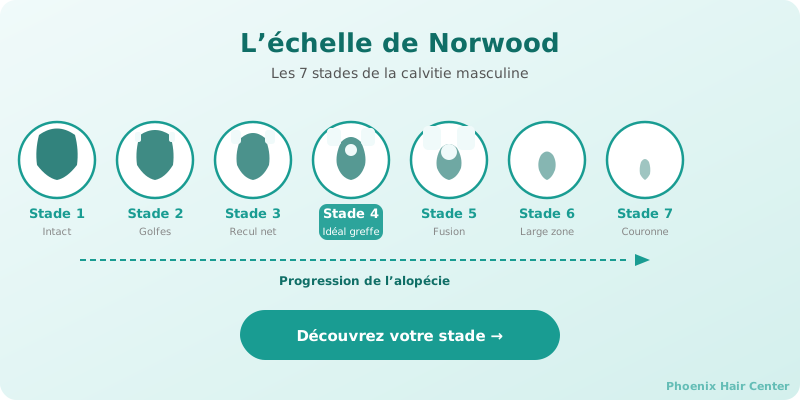
Created by Dr O'Tar Norwood in 1975, the Norwood Scale (or Hamilton-Norwood) is the worldwide reference system used by dermatologists and hair surgeons to classify the progression of androgenetic alopecia in men. It divides baldness into 7 stages, from mild recession of the temples to near-total loss of the frontal and crown areas.
Knowing your Norwood stage is an accurate diagnosis that allows the specialist to offer the most appropriate solution: monitoring, capillary PRP, medical treatments or FUE transplant.
The 7 Norwood stages in detail
Stage 1 — No visible loss
The frontal line is intact, with no recession. This is the starting reference. At this stage, no intervention is needed, but preventive monitoring may be considered if there is a family history.
Stage 2 — Slight temple recession
The temples begin to thin slightly, forming a subtle "M" shape. Many men stay at this stage all their lives. Recommended treatments: Minoxidil, supplements, monitoring.
Stage 3 — Marked temple recession
Temporal recession becomes clearly visible. This is often the first stage where baldness is perceived as a problem. Stage 3 vertex (variant) adds thinning at the crown. Recommended treatments: capillary PRP, Finasteride, early FUE evaluation.
Stage 4 — Frontal loss and widened vertex
The frontal area recedes significantly and the crown thins. A strip of hair still separates the two areas. This is the ideal stage for a first FUE transplant: the donor area is still very dense and the surgeon can achieve a natural, durable result.
Stage 5 — Fusion of frontal and vertex areas
The strip of separation between the front and the crown thins considerably. The surface to cover increases. An FUE transplant remains entirely possible, but requires strategic graft planning for a harmonious result.
Stage 6 — Large bald area
Front and crown now form a single bald area. Only the back crown and sides retain hair. A transplant is possible but requires optimal graft capital management, with realistic goals discussed during consultation.
Stage 7 — Advanced baldness
Only a thin horseshoe crown of hair remains. The donor area is limited. A transplant can still improve the frontal line or crown density, but expectations must be clearly defined with the surgeon.
Which treatment for each stage?
Why does it matter before a transplant?
Consultation at Phoenix Hair Center always starts with your Norwood stage evaluation. Why? Because this diagnosis determines:
- The number of grafts needed for a natural result
- The distribution strategy between the frontal line and the vertex
- The preservation of the donor area for possible future sessions
- The choice between classic FUE and DHI depending on the area to treat
- The value of a complementary treatment (PRP, Minoxidil) to stabilize hair loss
Can you be Norwood 3 at 25?
Yes, and it's more common than you might think. Androgenetic alopecia can begin in late adolescence. For young patients, it's crucial to avoid rushing into transplantation: hair loss may still progress. The Phoenix Hair Center team then favors a stabilization protocol (PRP + treatments) before considering surgery.
The Norwood stage for women?
The Norwood scale is specific to male baldness. For women, we use the Ludwig scale, which classifies diffuse thinning into 3 grades. Female loss follows a different pattern: the central part widens rather than frontal recession. Discover our dedicated article on female hair transplantation.
« Each stage has its solution. The mistake is to wait too long or to intervene too early. Our role is to guide you at the right moment. »
— Phoenix Hair Center medical team
Next step: your free diagnosis
Don't know what stage you are at? Our specialists perform a complete and free capillary diagnosis, at the clinic or via video. In 30 minutes, you'll know exactly where you stand and what your options are.