Dreaming of regaining thick, natural hair through an FUE hair transplant? It's an exciting prospect — but before you start picturing the result, there's a step that many clinics gloss over and that Phoenix Hair Center refuses to skip: a thorough medical evaluation. Because hair transplantation, however advanced it may be, is not for everyone — at least, not at any given time. Certain medical conditions can compromise healing, destroy grafts, or put your health at risk. This transparent guide gives you all the keys to know whether you're eligible, whether you should wait, or whether an alternative is preferable.
Why discuss contraindications?
A hair transplant is a surgical procedure. Even performed under local anaesthesia, it involves micro-incisions, a healing phase, and an immune response from your body to integrate the grafts. If your body isn't able to respond properly — due to an active disease, a heavy treatment, or a particular physiological state — the result can be compromised, or even dangerous.
At Phoenix Hair Center, we prefer to refuse or postpone a procedure rather than perform it under conditions that don't guarantee optimal results and total patient safety.
Major (absolute) contraindications
These situations make the transplant impossible or strongly inadvisable until they are resolved or stabilised:
Active autoimmune diseases
Lupus, rheumatoid arthritis, ankylosing spondylitis, vitiligo, progressive psoriasis, alopecia areata… When the disease is active or unstable, the immune system may attack the transplanted grafts, rendering the procedure useless — or even making things worse.
Active scarring or fibrosing alopecia
The inflammatory or autoimmune environment destroys existing follicles. Grafting into an area where inflammation is still present is like planting seeds in toxic soil: the grafts won't take.
Severe clotting disorders
Haemophilia, significant thrombocytopaenia, severe anaemia, or poorly managed anticoagulant treatment. The risk: excessive bleeding during the procedure, poor healing, and a sharply reduced graft survival rate.
Active scalp infection or inflammation
Fungal infection, severe dermatitis, inflammatory psoriasis, any untreated lesion… Operating on an infected or inflamed scalp is an absolute contraindication. The risk of superinfection and failure is too high.
Uncontrolled diabetes
Diabetes with a high HbA1c and no stabilised treatment seriously compromises healing and increases the risk of post-operative infection. This is often a temporary contraindication: once glycaemic balance is restored, the transplant becomes an option again.
Significant immunodeficiency
Ongoing chemotherapy, heavy biologic treatment, high-dose immunosuppressants… A weakened immune system cannot ensure healing or graft integration.
Unstabilised psychiatric disorders
Schizophrenia, delusional disorders, untreated trichotillomania, or manifestly unrealistic expectations. A transplant requires a clear understanding of the project, realistic expectations, and the ability to follow the post-operative protocol.
Pregnancy and breastfeeding
Generally inadvisable as a precaution. Local anaesthesia, surgical stress, and post-operative medications represent unnecessary risks for mother and child.
Cases not to overlook
- Insufficient donor area: not a medical "absolute" contraindication, but it can make the procedure impossible or pointless if the demand exceeds what the donor area can supply.
- Scalp cancer or poorly controlled local pathology: must be formally ruled out before any transplant.
- Unstabilised diffuse alopecia: a transplant is often inadvisable while hair loss continues — there's a risk of grafting into an area that keeps thinning.
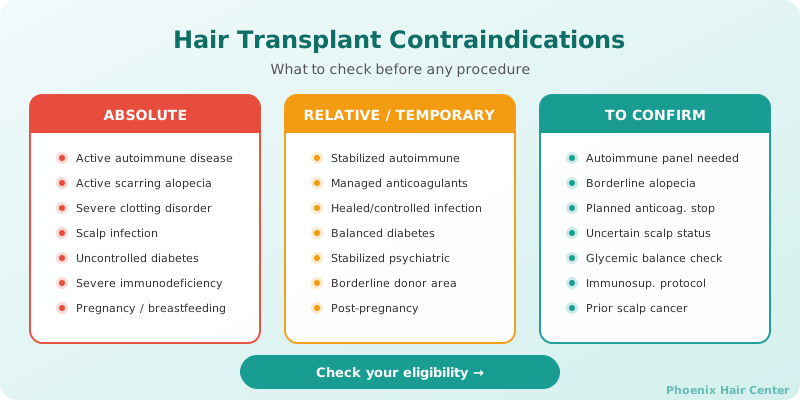
Complete table: absolute, relative, or to confirm?
This table summarises all contraindications at three severity levels. It's a decision-support tool, not a diagnosis — only a doctor can definitively determine your eligibility.
Contraindication ≠ end of hope
A contraindication is not necessarily permanent. Many situations classified as "absolute" are actually temporary: diabetes can be balanced, an infection treated, a psychiatric disorder stabilised. The key is not to rush things.
At Phoenix Hair Center, when we identify a contraindication, we don't simply say "no." We offer you a preparation pathway:
- Referral to the appropriate specialist (dermatologist, endocrinologist, psychiatrist…)
- Complementary treatments in the meantime (capillary PRP, Minoxidil, supplements)
- Regular follow-up to reassess your eligibility
- Rescheduling the transplant as soon as conditions are met
How does the assessment work at Phoenix Hair Center?
Our free pre-operative consultation is much more than a simple visual scalp examination. It includes:
- A comprehensive medical questionnaire: history, ongoing treatments, allergies, chronic conditions
- A clinical scalp examination and donor area assessment
- A hair analysis to evaluate density, calibre, and follicle vitality
- If needed, additional tests (blood work, biopsy, specialist referral)
- A transparent discussion about expected results, risks, and alternatives
"Our responsibility is not to transplant as many patients as possible, but to transplant the right patients at the right time. That's what makes the difference between a spectacular result and a disappointment."
— Phoenix Hair Center Medical Team
Ready to check your eligibility?
Have doubts about a contraindication? Taking medication and unsure if it's compatible? Don't stay in the dark. Our specialists perform a complete, free hair diagnosis — at our Paris clinic or via video consultation — to give you a clear answer and a personalised action plan.